What This Page Explains
This page explains:
- What methylene blue is
- How it affects dormant cancer cells
- How it impacts mitochondria and metabolism
- Where it may help
- Where it may create risk
- Why timing and context matter
What Is Methylene Blue?
Methylene blue is a synthetic compound used in medicine for various conditions.
Simple Explanation
- It affects how cells produce energy
- It interacts with mitochondria
- It changes oxidative balance
Why Methylene Blue Matters in Cancer
Methylene blue directly affects the electron transport chain, which is central to energy production.
Dormant cancer cells depend on:
- Efficient energy use
- Stable mitochondrial function
Methylene blue interferes with this.
Where This Fits in the System
Start here:
Methylene blue primarily affects:
- Mitochondria
- Metabolism
- Oxidative balance
- Survival systems
How Methylene Blue Affects Dormant Cancer Cells
Dormant cells survive by maintaining controlled, efficient energy production.
Methylene blue disrupts this balance.
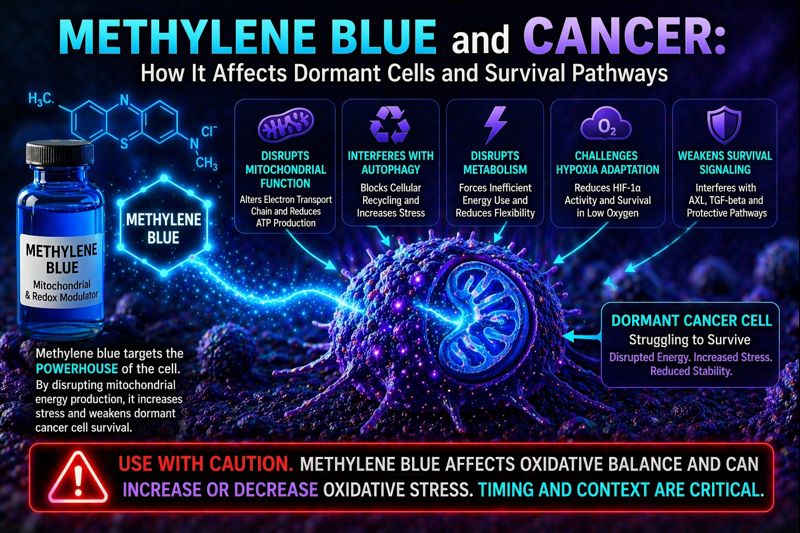
1. Mitochondrial Function (Primary Effect)
Mitochondria produce energy (ATP).
What Methylene Blue Does
- Alters electron transport chain activity
- Changes energy flow
- Can disrupt ATP production
Result
Dormant cells lose stable energy control.
2. Oxidative Stress Modulation
This is a key difference.
What Methylene Blue Does
- Can increase oxidative stress in some conditions
- Can reduce it in others
Result
It creates instability in cellular balance.
3. Metabolic Disruption
Cancer cells adapt energy systems.
What Methylene Blue Does
- Disrupts metabolic flexibility
- Forces inefficient energy use
Result
Cells become stressed and less adaptable.
4. Autophagy Interaction
Dormant cells rely on recycling systems.
What Methylene Blue Does
- Interferes with survival recycling
- Increases internal stress
Result
Cells struggle to maintain long-term survival.
5. Hypoxia and Stress Conditions
Dormant cells often survive in low oxygen.
What Methylene Blue Does
- Disrupts adaptation to low oxygen
- Increases stress under hypoxia
Result
Cells become more vulnerable in harsh environments.
Where Methylene Blue Can Help
Methylene blue may help when:
- Targeting mitochondrial function
- Disrupting energy production
- Increasing stress on dormant cells
- Reducing metabolic flexibility
Where Methylene Blue Can Create Risk (Critical Section)
This is extremely important.
Methylene Blue Alters Oxidative Balance
It is not a simple antioxidant.
Potential Problem
It can:
- Increase oxidative stress unpredictably
- Interfere with controlled treatment effects
Interaction With Treatments
Because it affects oxidative balance:
- It may amplify or reduce treatment effects
- It may create unpredictable outcomes
DO NOT USE WITHOUT UNDERSTANDING TIMING AND CONTEXT
Especially important with:
- Chemotherapy
- Radiation
- Any oxidative-based therapy
Key Risk
Uncontrolled oxidative changes can:
- Damage healthy cells
- Protect cancer cells in some cases
- Increase resistance if misused
Timing Is Critical
Methylene blue is highly context-dependent.
It Depends On:
- Dose
- Timing
- Combination with other therapies
- Cellular environment
Strategic Role of Methylene Blue
Methylene blue is best understood as:
- A mitochondrial disruptor
- A redox modulator
- A system destabilizer
How It Fits Into a Complete Strategy
From the system:
Step 1: Destabilize Dormancy
Methylene blue helps
Step 2: Remove Survival Systems
Methylene blue strongly helps
Step 3: Eliminate Cells
Methylene blue does NOT complete this
Why Methylene Blue Is Unique
Compared to other compounds:
- Direct mitochondrial interaction
- Strong metabolic effects
- Complex oxidative behavior
Why Methylene Blue Alone Is Not Enough
It can:
- Disrupt energy systems
- Increase stress
But it does NOT:
- Eliminate cancer cells completely
- Replace immune function
- Replace treatment
Key Takeaways
- Methylene blue directly affects mitochondria
- It disrupts energy production in dormant cells
- It alters oxidative balance in complex ways
- It increases stress on survival systems
- It must be used carefully due to unpredictable effects
- Timing and context are critical
External References
National Cancer Institute
https://www.cancer.gov/about-cancer/understanding/what-is-cancer
Frontiers in Oncology
https://www.frontiersin.org/articles/10.3389/fonc.2019.00019/full
Nature Reviews Cancer
https://www.nature.com/articles/nrc.2017.15
Continue Learning
Main system:
Related pages:
https://helping4cancer.com/cancer-metabolic-evasion/
https://helping4cancer.com/autophagy-cancer-survival/
https://helping4cancer.com/cancer-dormancy/
Disclaimer
This content is for educational purposes only and is not medical advice.