What This Page Explains
This page explains:
- How the immune system normally detects cancer
- Why cancer cells should be destroyed
- How cancer hides from immune cells
- How immune evasion allows survival
- Why this is critical for cancer spread and dormancy
The Immune System Should Stop Cancer
From the previous page:
👉 https://www.helping4cancer.com/nk-t-cell-cancer
We learned:
- NK cells attack quickly
- T cells attack precisely
So logically:
👉 Cancer should not survive
The Reality
Cancer survives because it learns how to hide.
If cancer is seen, it is destroyed
If cancer is hidden, it survives
What Is Immune Evasion?
Immune evasion means:
👉 Cancer avoids being detected or attacked by the immune system
This is one of the most important survival mechanisms in cancer.
How the Immune System Detects Cancer
Before understanding how cancer hides, we need to understand detection.
Normal Detection
Immune cells look for:
- Abnormal proteins
- Stress signals
- Missing “self” markers
If something looks wrong:
👉 The immune system attacks
How Cancer Hides (Core Mechanisms)
Cancer uses multiple strategies at the same time.
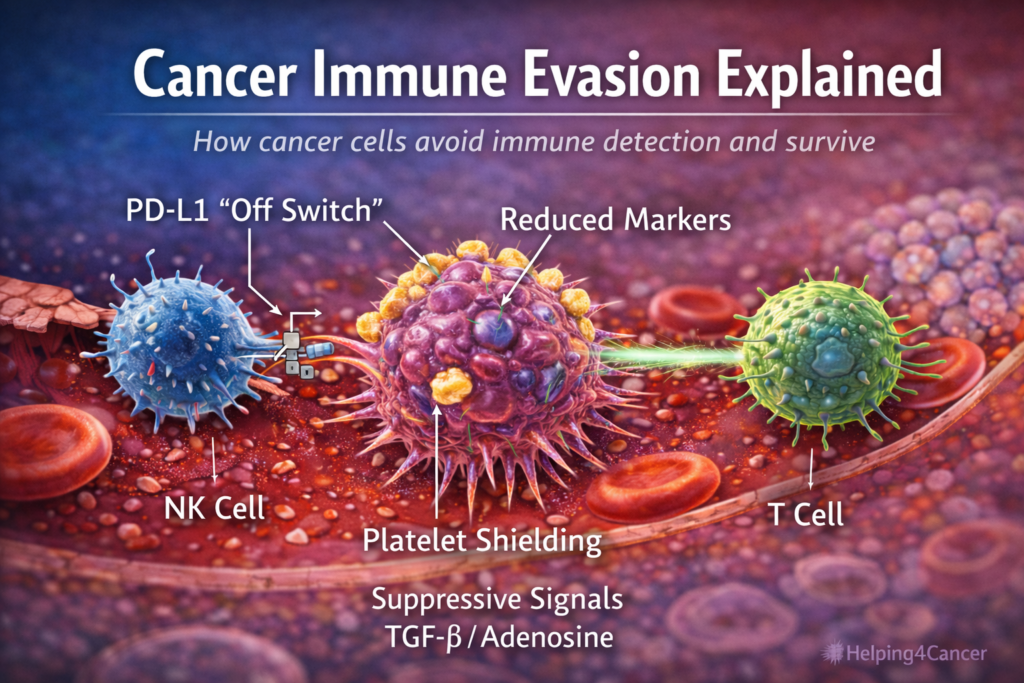
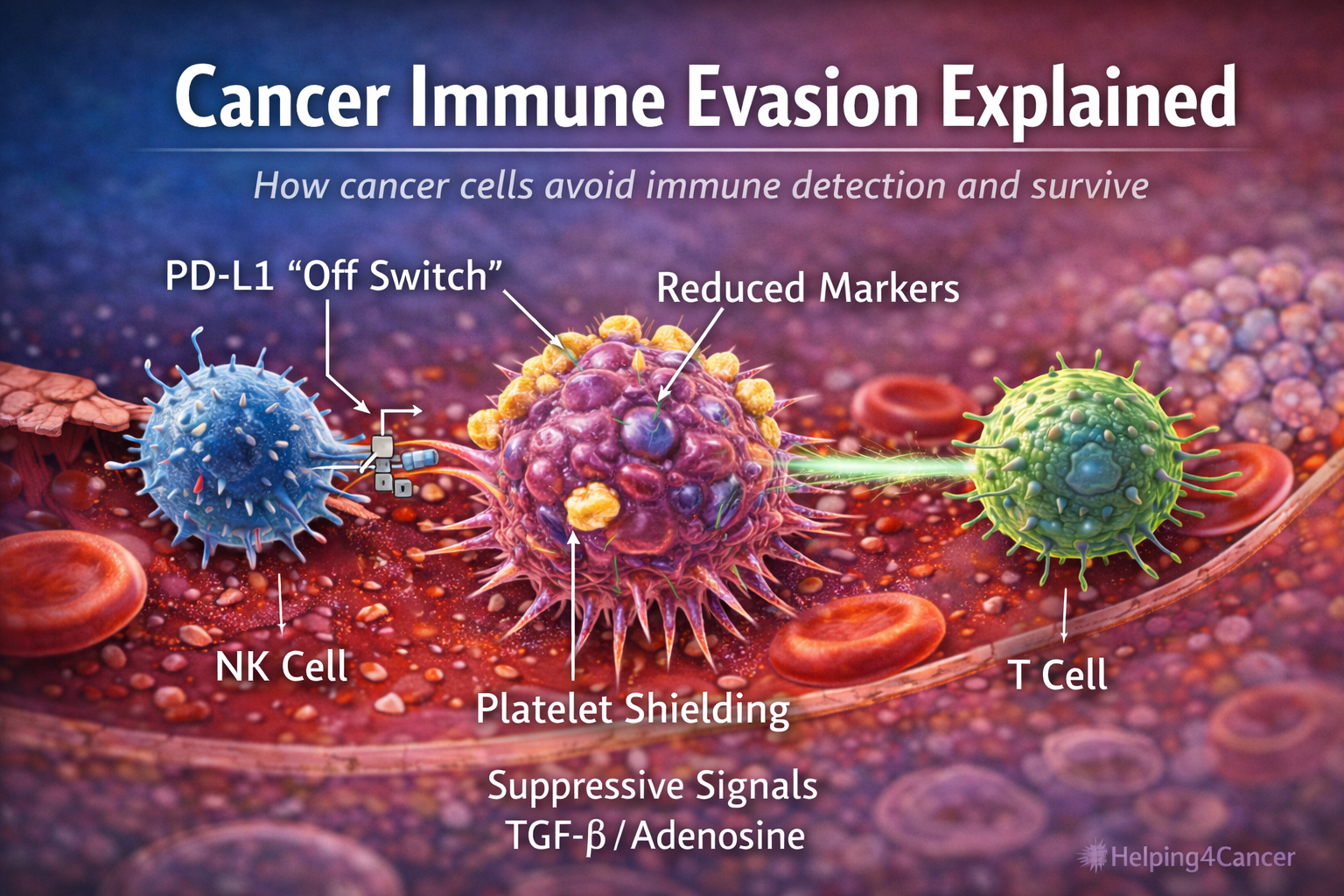
1. PD-L1 (Immune “Off Switch”)
One of the most important mechanisms.
What PD-L1 Does
Cancer cells express PD-L1 on their surface.
This interacts with immune cells and tells them:
👉 “Do not attack”
Result
- T cells are turned off
- The immune response is suppressed
2. Hiding Identification Markers
T cells rely on markers to detect cancer.
Cancer can reduce these markers.
What Happens
- T cells cannot recognize the cancer
- The cell appears normal
3. Blocking NK Cell Detection
NK cells detect abnormal or missing signals.
Cancer can adjust these signals.
Result
- NK cells do not activate
- Early immune response is weakened
4. Platelet Cloaking
From earlier pages:
👉 https://www.helping4cancer.com/cancer-bloodstream-survival
Cancer cells can cover themselves with platelets.
What This Does
- Physically hides the cancer cell
- Makes it look like normal tissue
- Reduces immune detection
5. Releasing Suppressive Signals
Cancer cells release chemicals that weaken immune cells.
Examples
- TGF-beta
👉 https://www.helping4cancer.com/tgf-beta-cancer - Adenosine
👉 https://www.helping4cancer.com/cancer-adenosine-immune
Result
- Immune cells become less active
- The environment becomes suppressive
6. Changing the Environment
Cancer modifies its surroundings.
Key Changes
- Low oxygen (hypoxia)
👉 https://www.helping4cancer.com/tumor-hypoxia-hif1a - Acidic environment (lactate)
👉 https://www.helping4cancer.com/cancer-lactate-acid
What This Does
- Weakens immune cells
- Makes detection harder
7. Mechanical Evasion (Physical Hiding)
Cancer cells can change their physical structure.
What Happens
- Cells become softer
- Cells become more flexible
- Immune cells cannot attach properly
Learn more:
👉 https://www.helping4cancer.com/cancer-mechanical-evasion
Why Immune Evasion Is Critical
Without immune evasion:
👉 Cancer would be eliminated early
With immune evasion:
👉 Cancer survives and spreads
Connection to Circulating Tumor Cells
From Page 1:
👉 https://www.helping4cancer.com/circulating-tumor-cell
Cancer cells entering the bloodstream must avoid immune attack.
Immune evasion allows:
- Survival in blood
- Travel to new locations
Connection to Dormancy
Immune evasion also explains dormancy.
Learn more:
👉 https://www.helping4cancer.com/cancer-dormancy
What Happens
Instead of being destroyed:
- Cancer is controlled
- Cancer becomes inactive
- Cancer survives
Why Cancer Can Return Years Later
Cancer is not always eliminated.
Sometimes it is:
👉 Hidden
Over Time
- Immune pressure changes
- The environment shifts
- Cancer becomes active again
Learn more:
👉 https://www.helping4cancer.com/cancer-reactivation-recurrence
The Most Important Concept
Cancer survival depends on avoiding detection
Not just growing.
Not just spreading.
👉 Avoiding the immune system
How This Connects to the Full System
This page connects directly to:
- Circulating tumor cells
→ https://www.helping4cancer.com/circulating-tumor-cell - Bloodstream survival
→ https://www.helping4cancer.com/cancer-bloodstream-survival - Immune system basics
→ https://www.helping4cancer.com/nk-t-cell-cancer - Dormancy
→ https://www.helping4cancer.com/cancer-dormancy
Key Takeaways
- The immune system is designed to destroy cancer
- Cancer survives by hiding from detection
- PD-L1 can turn off immune cells
- Cancer reduces markers to avoid recognition
- Platelets can shield cancer cells
- The tumor environment suppresses immunity
- Immune evasion allows cancer to spread and persist
External References
National Cancer Institute – Immune Evasion
https://www.cancer.gov/about-cancer/treatment/types/immunotherapy
Nature Reviews Cancer – Immune Escape
https://www.nature.com/articles/nrc.2017.35
Frontiers in Immunology
https://www.frontiersin.org/articles/10.3389/fimmu.2020.00939/full
Continue Learning
Next page:
👉 https://www.helping4cancer.com/cancer-extravasation
Also explore:
- https://www.helping4cancer.com/cancer-dormancy
- https://www.helping4cancer.com/autophagy-cancer-survival
- https://www.helping4cancer.com/p38-erk-cancer