What This Page Explains
This page explains:
- What cancer dormancy is
- Why dormant cancer cells are dangerous
- The biology behind dormancy (p38 vs ERK)
- How dormant cells survive long-term
- Strategies that may interfere with dormancy
- How to think about disruption vs elimination
What Is Cancer Dormancy?
Cancer dormancy is a state where cancer cells are:
- Alive
- Not dividing
- Not forming detectable tumors
Simple explanation:
The cell is not dead.
The cell is not growing.
The cell is surviving.
👉 It is “sleeping,” not gone.
Why Dormancy Matters
Dormancy is one of the biggest reasons cancer can return years later.
After treatment:
- Some cancer cells survive
- These cells spread through the body
- They settle into new tissue
- They stop growing and become dormant
These are often called disseminated tumor cells (DTCs).
👉 Learn more:
https://www.helping4cancer.com/disseminated-tumor-cell/
The Core Control System: p38 vs ERK
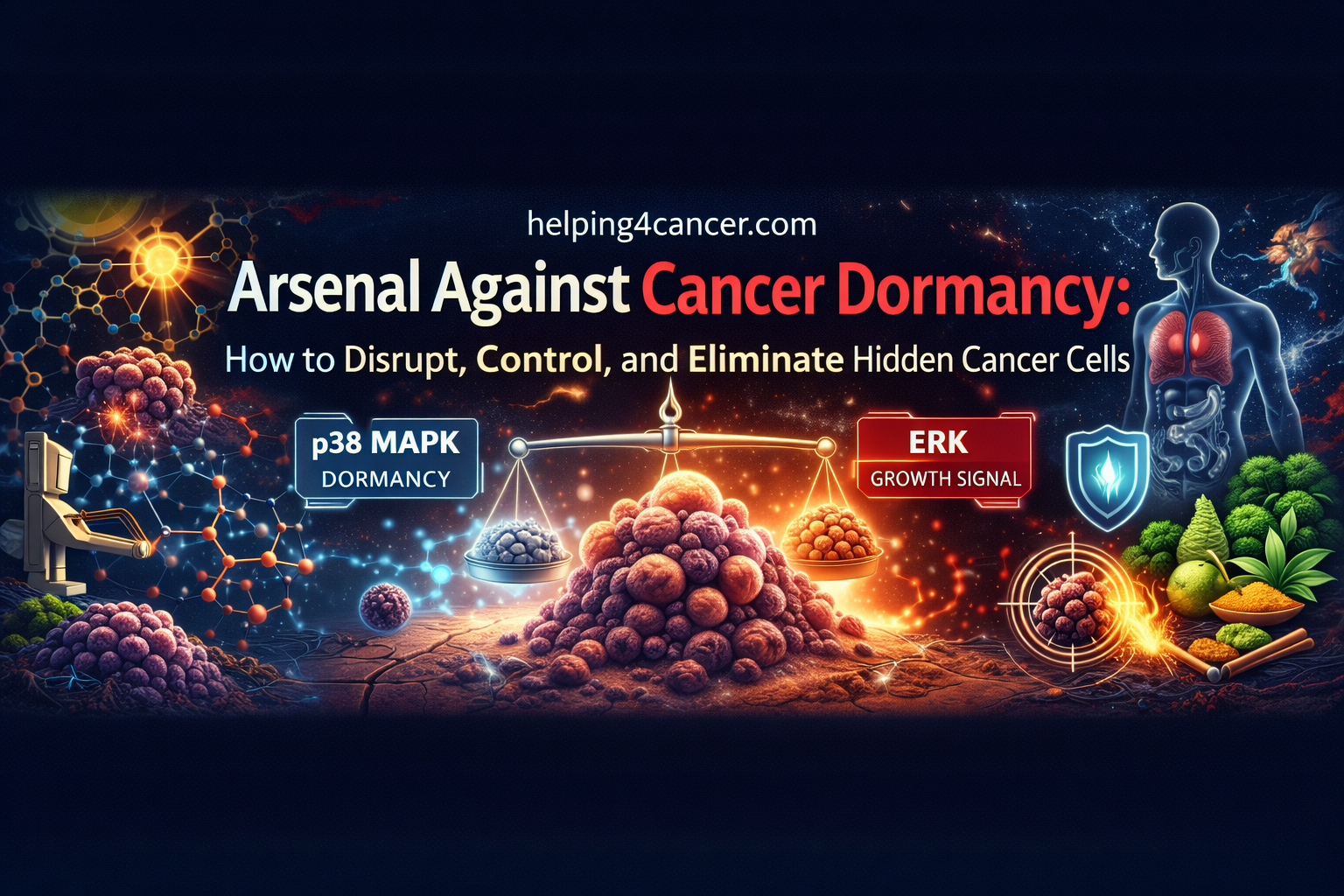
Cancer dormancy is controlled by a balance between two major signals:
- p38 MAPK signaling pathway → “sleep / stress signal”
- ERK pathway → “growth / division signal”
The Balance
- High p38 + Low ERK → Dormancy
- Low p38 + High ERK → Growth
- Extreme stress → Cell death
This is often called the p38–ERK switch.
Why Cancer Cells Enter Dormancy
Most environments in the body are not ideal for growth.
Dormancy happens when cancer cells face:
- Low nutrients
- Low oxygen (hypoxia)
- Immune pressure
- Lack of blood supply
- Harsh microenvironment
Instead of dying, the cell adapts.
👉 It chooses survival over growth.
How Dormant Cells Survive
Dormant cancer cells are not inactive. They are highly adaptive.
1. Autophagy (Self-Recycling)
Cells break down their own components to survive stress.
👉 Learn more:
https://www.helping4cancer.com/autophagy-cancer-survival/
2. Immune System Control
The immune system often:
- Does not fully eliminate the cell
- Keeps it suppressed instead
👉 Learn more:
https://www.helping4cancer.com/nk-t-cell-cancer/
3. Metabolic Adaptation
Dormant cells shift metabolism to survive:
- Lower energy usage
- Increased efficiency
- Resistance to stress
👉 Learn more:
https://www.helping4cancer.com/cancer-metabolic-evasion/
The Danger: Dormant Cells Are Hard to Kill
Most cancer treatments target dividing cells.
Dormant cells are:
- Not dividing
- Less visible to the immune system
- Resistant to chemotherapy and radiation
👉 This makes them one of the biggest challenges in cancer treatment.
The Arsenal Against Dormancy
There is no single “dormancy cure.”
Instead, strategies fall into three categories:
- Maintain dormancy (containment)
- Disrupt dormancy (destabilize)
- Eliminate cells (kill phase)
1. Maintaining Dormancy (Containment Strategy)
The goal here is:
👉 Keep cancer cells asleep and controlled
This may involve:
- Supporting immune surveillance
- Maintaining metabolic pressure
- Avoiding conditions that favor growth
Key Mechanisms
- Stable p38 signaling
- Active immune control
- Limited nutrient availability
Potential Support Compounds
- Vitamin D3
- Beta-glucans (immune support)
- Zinc
- Medicinal mushrooms (Turkey Tail)
👉 These focus on control, not elimination.
2. Disrupting Dormancy (Destabilization Strategy)
This is where things get interesting.
Dormancy is a fragile balance.
If you disrupt that balance:
- The cell may die
- The cell may weaken
- Or the cell may reactivate
👉 The goal is controlled destabilization.
Compounds That Interfere with Dormancy Signaling
Flavonoids and Polyphenols
- Quercetin
- Apigenin
- Fisetin
These compounds:
- Modulate p38 signaling
- Interfere with survival pathways (NF-κB, PI3K/Akt)
- Alter oxidative stress balance
👉 They do not simply “wake cells up”
👉 They destabilize the system
Metabolic Disruptors
- Berberine
- Resveratrol
These:
- Activate AMPK
- Disrupt energy balance
- Interfere with survival signaling
👉 This can weaken dormant cells over time.
Signaling Modulators
- Curcumin
- EGCG
These compounds:
- Modulate inflammation
- Influence p38 activity
- Interfere with cancer signaling networks
👉 Again, not a simple on/off effect.
3. Stress and Kill Strategy (Elimination Phase)
Dormant cells can survive moderate stress.
But they can die under extreme stress.
Pro-Stress Compounds
These increase internal stress:
- Sulforaphane
- Artemisinin
- Andrographolide
These can:
- Increase reactive oxygen species (ROS)
- Activate stress pathways like p38
- Push cells toward apoptosis
👉 This is where dormancy can break toward cell death
The Key Concept: Stress Threshold
Dormant cells exist in a narrow survival zone:
- Too little stress → growth
- Moderate stress → dormancy
- Too much stress → death
👉 The goal is to push beyond the survival threshold
The Microenvironment Matters
Dormancy is heavily influenced by the environment around the cell.
Key factors:
- Oxygen levels
- Nutrient supply
- Immune activity
- Acidity (pH)
👉 Learn more:
https://www.helping4cancer.com/tumor-microenvironment/
Why “Waking Up Cancer” Is Risky
Some theories suggest:
👉 Wake dormant cells → then kill them
But this carries risk:
- Reactivation may outpace elimination
- Growth signals may dominate
- Tumors may form rapidly
👉 This is why destabilization + stress is often safer than pure reactivation.
A Better Framework: Control → Destabilize → Eliminate
Instead of thinking in extremes:
Use a layered approach:
Phase 1: Control
- Maintain immune pressure
- Limit growth conditions
Phase 2: Destabilize
- Disrupt signaling
- Interfere with survival pathways
Phase 3: Eliminate
- Increase stress
- Push toward apoptosis
Why This Strategy Makes Sense
Dormant cells are:
- Resistant to single approaches
- Adaptable to stress
- Protected by their environment
👉 A multi-layered approach is more effective in theory.
Limitations and Reality
Important:
- Dormancy is not fully understood
- Human outcomes vary widely
- Most evidence is mechanistic or preclinical
- Clinical translation is complex
👉 This is educational, not a treatment protocol.
Key Takeaways
- Dormant cancer cells are alive but inactive
- High p38 signaling helps maintain dormancy
- Dormancy is controlled by the p38–ERK balance
- Many compounds interfere with this balance
- There is no simple “on/off switch” for dormancy
- Effective strategies focus on:
- Control
- Destabilization
- Elimination
Final Thought
Cancer dormancy is not a passive state.
It is an active survival strategy.
Understanding how to:
- Disrupt it
- Control it
- And push cells beyond survival
👉 May be one of the most important concepts in long-term cancer outcomes.
Suggested Internal Links
Use these throughout your site:
- https://www.helping4cancer.com/cancer-dormancy
- https://www.helping4cancer.com/p38-erk-cancer
- https://www.helping4cancer.com/autophagy-cancer-survival
- https://www.helping4cancer.com/cancer-metabolic-evasion
- https://www.helping4cancer.com/cancer-immune-evasion
Arsenal Against Cancer Dormancy explains how dormant cancer cells survive through p38 signaling, metabolic adaptation, and immune evasion. This guide explores strategies to disrupt dormancy, maintain control, and eliminate hidden cancer cells before recurrence.