What This Page Explains
This page explains:
- What a disseminated tumor cell (DTC) is
- How cancer cells hide after leaving the bloodstream
- Why these cells do not grow immediately
- How they survive long-term
- Why they are important in recurrence
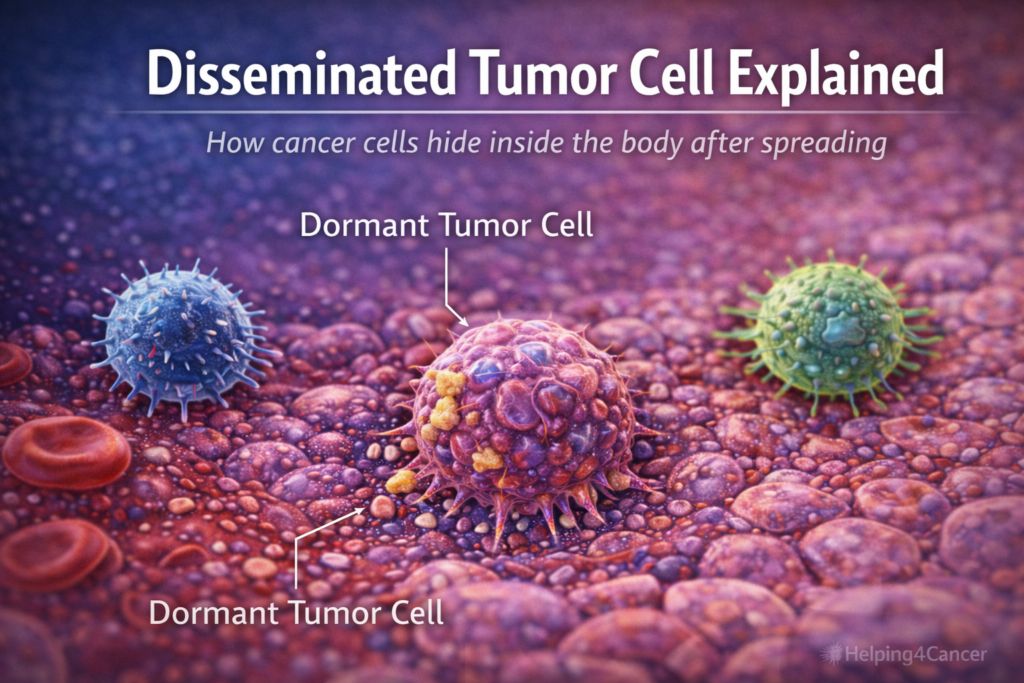
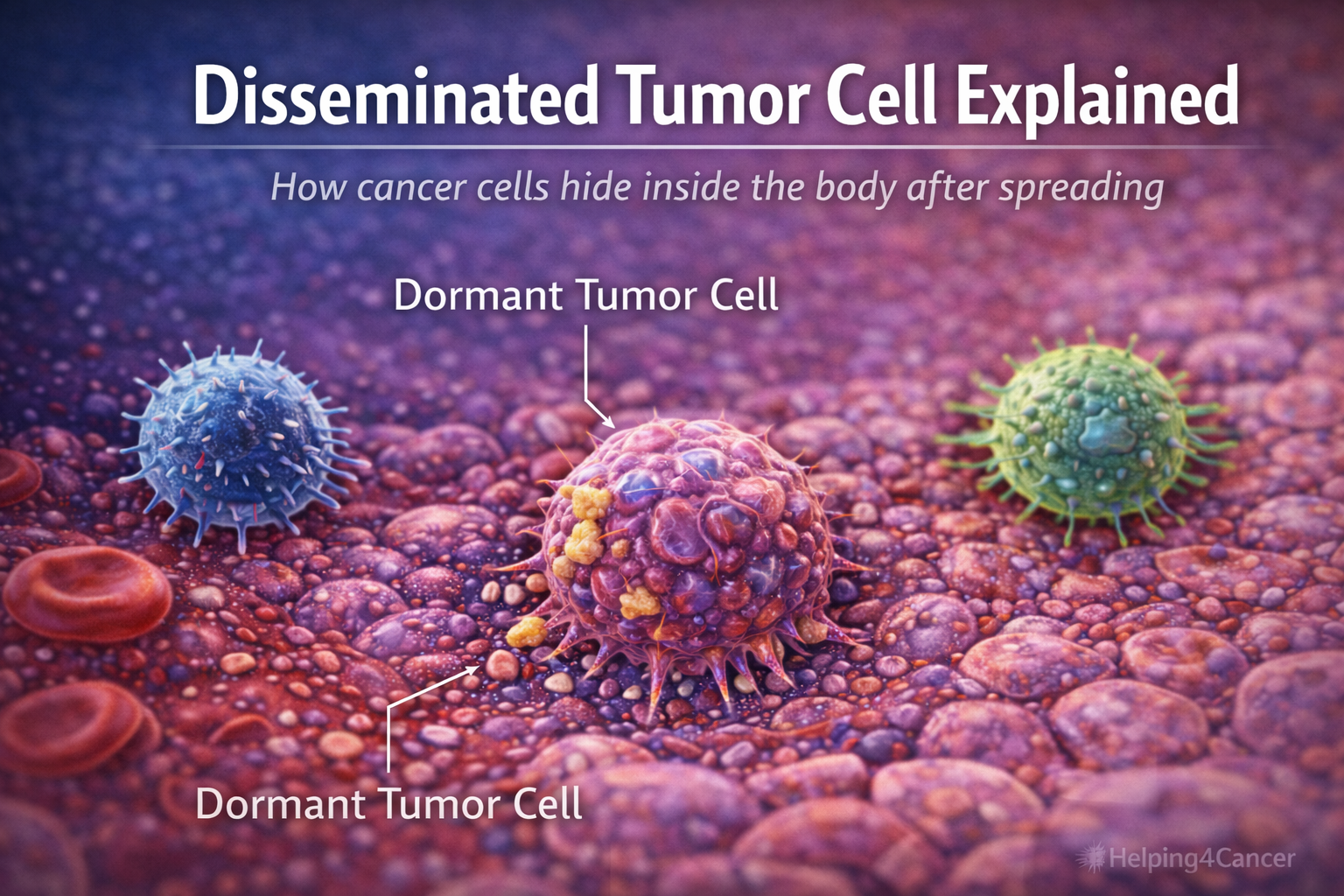
What Is a Disseminated Tumor Cell?
A disseminated tumor cell (DTC) is a cancer cell that has:
- Left the bloodstream
- Entered new tissue
- Survived initial immune attack
Simple Explanation
- Cancer spreads
- A cell travels through the blood
- The cell exits into tissue
- The cell hides
👉 That hidden cell is a DTC
How This Connects to Previous Steps
From earlier pages:
- Circulating tumor cells
👉 https://www.helping4cancer.com/circulating-tumor-cell - Bloodstream survival
👉 https://www.helping4cancer.com/cancer-bloodstream-survival - Extravasation
👉 https://www.helping4cancer.com/cancer-extravasation
Only cells that complete all these steps become DTCs.
Why Disseminated Tumor Cells Are Important
DTCs are critical because:
👉 They are the cells that can cause cancer to return
They are:
- Hidden
- Hard to detect
- Resistant to treatment
Why DTCs Do Not Grow Right Away
Most people assume cancer spreads and grows immediately.
That is not usually what happens.
The Reality
Most disseminated tumor cells do not grow immediately
Instead, they enter a survival state.
The Challenges DTCs Face
Once inside new tissue, cancer cells face major problems:
1. Immune Surveillance
The immune system is still active.
Learn more:
👉 https://www.helping4cancer.com/nk-t-cell-cancer
2. Lack of Nutrients
New tissue may not support growth.
3. Unfamiliar Environment
The cell must adapt to a completely new location.
The Survival Strategy: Dormancy
To survive, DTCs enter:
👉 Dormancy
Learn more:
👉 https://www.helping4cancer.com/cancer-dormancy
What Dormancy Means
- The cell stops dividing
- The cell uses minimal energy
- The cell avoids detection
Why Dormancy Works
Dormancy allows cancer cells to:
- Avoid immune destruction
- Survive harsh conditions
- Wait for better conditions
Where DTCs Hide
DTCs often hide in specific areas of the body.
Common Locations
- Bone marrow
- Liver
- Lung
- Brain
Why These Locations
These areas provide:
- Protection
- Support signals
- Reduced immune activity
How DTCs Avoid Detection
Even after leaving the bloodstream, cancer must continue hiding.
Key Mechanisms
- Immune evasion
👉 https://www.helping4cancer.com/cancer-immune-evasion - Reduced activity (less visible)
- Low metabolic state
The Role of the Microenvironment
The surrounding tissue plays a major role.
Learn more:
👉 https://www.helping4cancer.com/tumor-microenvironment/
What It Does
- Provides survival signals
- Controls growth or dormancy
- Influences immune activity
Key Survival Mechanism: Autophagy
DTCs rely heavily on autophagy.
Learn more:
👉 https://www.helping4cancer.com/autophagy-cancer-survival
What Autophagy Does
- Recycles cell components
- Provides energy
- Removes damage
Why This Matters
Without autophagy:
👉 Dormant cells would not survive
The Growth vs Dormancy Decision
Cancer cells constantly “decide”:
- Grow
- Or stay dormant
Controlled By:
- p38 vs ERK signaling
👉 https://www.helping4cancer.com/p38-erk-cancer
Result
- p38 → dormancy
- ERK → growth
Why DTCs Can Stay for Years
DTCs can survive for long periods because:
- They are hidden
- They use minimal energy
- The immune system controls them
Why Cancer Can Come Back
Cancer recurrence is often caused by DTCs.
What Happens
- Dormant cells remain
- Conditions change
- Cells reactivate
Learn more:
👉 https://www.helping4cancer.com/cancer-reactivation-recurrence
The Most Important Concept
Cancer does not always disappear
Sometimes it hides
How This Connects to the Bigger System
This page connects to:
- Circulating tumor cells
→ https://www.helping4cancer.com/circulating-tumor-cell - Bloodstream survival
→ https://www.helping4cancer.com/cancer-bloodstream-survival - Extravasation
→ https://www.helping4cancer.com/cancer-extravasation - Dormancy
→ https://www.helping4cancer.com/cancer-dormancy
What Comes Next
Next step:
👉 Full understanding of dormancy
Next page:
👉 https://www.helping4cancer.com/cancer-dormancy
Key Takeaways
- Disseminated tumor cells are cancer cells hidden in tissue
- They form after cancer leaves the bloodstream
- Most do not grow immediately
- They enter dormancy to survive
- They can remain for years
- They are a major cause of cancer recurrence
External References
National Cancer Institute
https://www.cancer.gov/about-cancer/understanding/what-is-cancer
Nature Reviews Cancer
https://www.nature.com/articles/nrc.2017.15
Frontiers in Oncology
https://www.frontiersin.org/articles/10.3389/fonc.2019.00019/full
Continue Learning
Next page:
👉 https://www.helping4cancer.com/cancer-dormancy
Also explore:
- https://www.helping4cancer.com/autophagy-cancer-survival
- https://www.helping4cancer.com/p38-erk-cancer
- https://www.helping4cancer.com/cancer-reactivation-recurrence